
SEEING THROUGH DRAWING How did these drawings come to life?


I’m here to tell you my story!!!
They didn’t appear overnight. They emerged from a long journey that began in childhood—through drawing, walking, travelling, and observing cities and people.

(There are no photos of me drawing because those were the days before we had a camera. :))
Ever since I was a child, I was always drawing and writing in my notebooks, diaries, and on any scraps of paper I could find.
Sometimes it was a feeling, sometimes a face, and sometimes simply a trace of something passing through me.

In middle school, we began painting in oils after school. Our art teacher, Emel, gave free art lessons to me and a few friends.
That classroom was our laboratory of discovery—a place where we could explore freely through examples from around the world.

With the guidance of our high school art teacher, I began working with pastels. She even brought a Zenit camera to school; we took photographs and printed them ourselves in the darkroom. It was incredibly exciting!
Singing was also part of my life. We had a wonderful choir and music room. Somehow, with great enthusiasm, I managed to make time for all of it. Among all the exam-prep books, I was looking for ways to express myself.

My path then led me to urban planning. Although we were expected to sketch, drawing and I had grown far apart. I wasn’t using my hand enough; instead, I was spending enormous energy learning new computer programs.
Analyses, syntheses, presentation boards, reports, Adobe PSD, and my dear Kevin Lynch—my fellow urban planners will know exactly what I mean. :)
At first, I wasn’t quite sure how to connect all this with drawing. Over time, I came to realise that cities, too, are vast stories that need to be read and drawn.

What fascinated me most about urban planning was the relationship a city forms with people.
How does a street transform?Why does a public square come alive?Why do people stop in one place? Why do they walk? How do they encounter one another, and what do they experience?
In a film set design course, I truly began drawing by hand again. I wrote the story of a woman journalist from the 1930s who lived in my home, then created drawings showing how I would redesign the space around her story.

Through academic work, university projects, and scholarship programmes, travel moved to the centre of my life.
During this time, I realised how much I enjoyed not simply seeing different cities, but exploring them on foot, getting lost in their streets, and experiencing them through the eyes of an urban planner.
Observing how a city flows, where it makes people pause, which streets invite you to walk, and which corners spark curiosity became an almost instinctive form of research for me.
I began recording what I saw not only through photographs, but also through quick sketches, short notes, and observations.

I went to Rome to conduct research for my master’s thesis.
While working on spatial perception and walkability, I realised that photographs alone were not enough to capture my observations.
Sometimes the rhythm of a street, the feeling of a passageway, or the way a square draws people in had to be understood—and communicated—through drawing.
My sketches thus became part of my research. Drawing became more than a way of recording what I saw; it became a way of understanding, thinking, and communicating.


During this period, I began drawing more in Kuzguncuk, the neighbourhood where I lived. Sometimes I drew a street corner, sometimes a tree or a storefront, and sometimes the everyday rhythm of the neighbourhood.
I met local shopkeepers, spent time in the streets, and noticed the small moments of daily life.
The more I drew, the deeper my relationship with the neighbourhood became. Drawing a place became a way of being more attentive—and more fully present—within it.
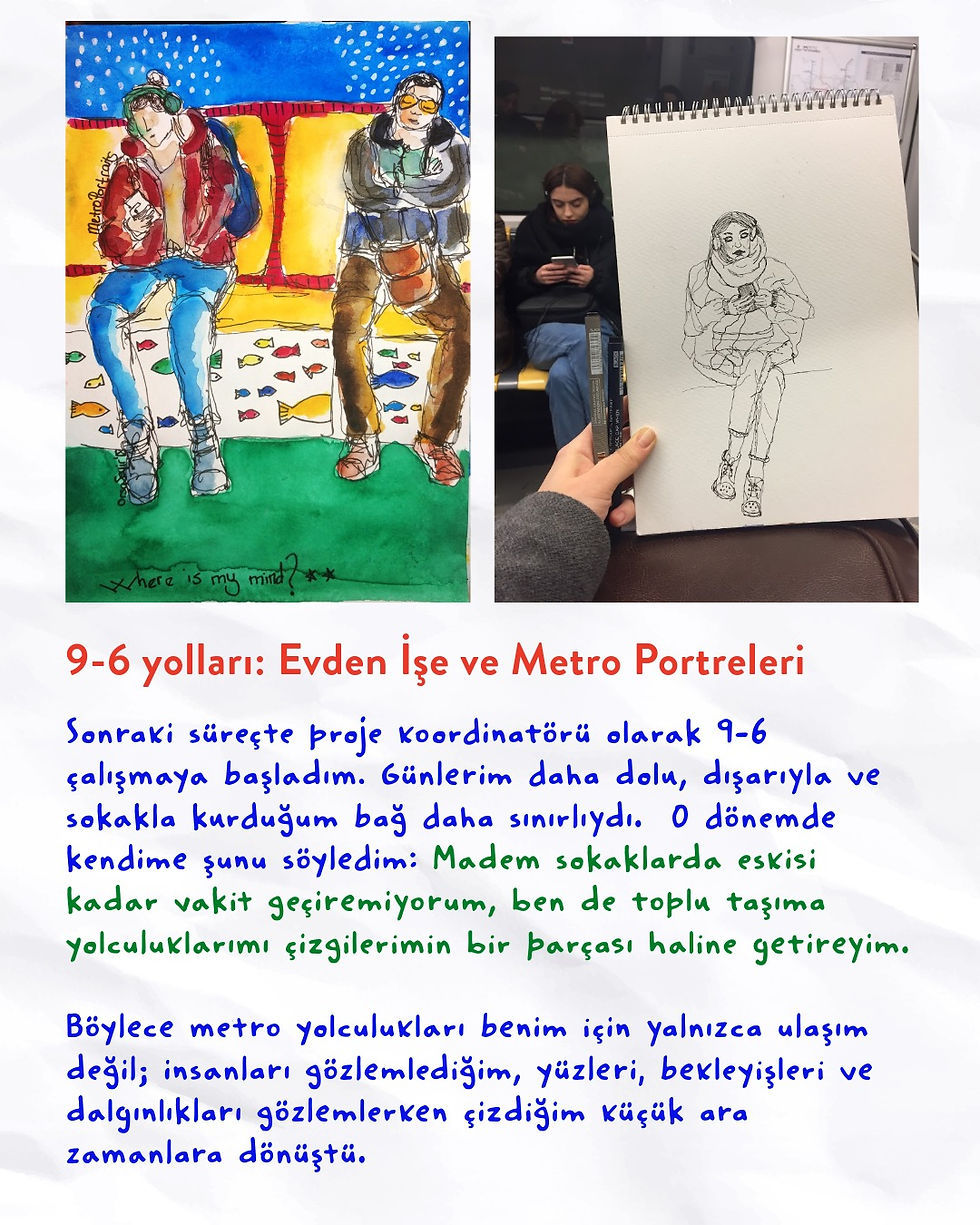
Later, I began working from nine to six as a project coordinator. My days became busier, and my connection with the outdoors and the streets grew more limited.
I told myself: If I can’t spend as much time in the streets as I used to, I can make my public-transport journeys part of my drawing practice.
Metro journeys became more than transportation. They became small pockets of time in which I observed people and drew their faces, their waiting, and their moments of distraction.

I had made myself a promise for my thirtieth birthday: when I turned thirty, I would do what mattered most to me.
For me, that meant returning to Rome.
I gifted myself a ticket and went back to those streets—to walk alone, get lost, look, and draw.
At one restaurant, the waiter asked, “Did you come alone? What are you doing?”
“Yes, I’m travelling by myself,” I replied.
Then they surprised me with tiramisu and limoncello for my birthday. Once again, I captured that moment by drawing it. :)
Fotoğrafın üzerindeki İtalyanca metin:
“Because she wished me a happy birthday! Thank you. You’re very kind.”


A few years later, I was invited to give a talk at ITU.
Soon afterwards, I was invited to teach Drawing in Architecture at the ITU Faculty of Architecture. It has now been more than five years since I began.
Drawing thus grew from a personal practice into a way of seeing and thinking that I share with architecture students.


For me, Seeing Through Drawing is the outcome of a long journey that changed the way I see life—long before it became a workshop.
The urge to draw since childhood, the desire to understand cities by walking through them, travel, people, streets, academia, design, and art…
Today, they all come together here:
To truly look at a place to think through drawing about what you see.And to build a more attentive relationship with the world.


Comments